The Trial of Nelson Mandela and the Rivonia Ten for Sabotage and Conspiracy
Representing Afrikaner nationalists and promoting White supremacy, the National Party gained control of the South African government In 1948. Their central policy, known as apartheid, aimed to segregate South Africans by race, ensuring that Whites maintained total control over the country and that their interests were prioritized over those of Black South Africans.
Apartheid had dire consequences for Black South Africans. Two thirds of the African population lived in extreme poverty, the infant mortality rate was thirteen times higher than that of White infants, and any form of protest was likely met with extreme violence from government forces.
Initially, the African National Congress (ANC), the largest Black political organization in South Africa, embraced nonviolent civil disobedience, leading to mass arrests and increased membership. Then, in March 1960, White police forces killed sixty-nine peaceful demonstrators in Sharpeville. The massacre prompted the ANC to create uMkhonto weSizwe, a separate group focused on sabotaging the apartheid government.
In retaliation for acts of sabotage, the government raided an ANC safehouse in Rivonia in 1963. The raid led to the arrest of key ANC leaders, including the charismatic Nelson Mandela, and culminated in the Rivonia Trial, where the defendants faced charges of sabotage and conspiracy. A guilty verdict, which seemed inevitable, could lead to a death sentence for Mandela and the others.
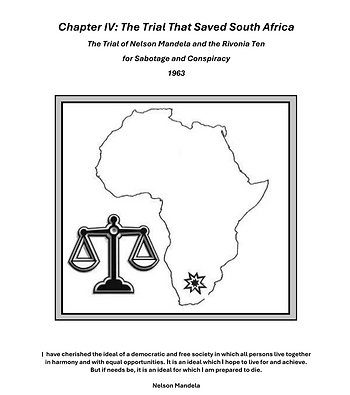
The trial provided a world stage for Mandela to declare, “I have cherished the ideal of a democratic and free society in which all persons live together in harmony and with equal opportunities. It is an ideal which I hope to live for and achieve. But if needs be, it is an ideal for which I am prepared to die.” It was a pronouncement—and a trial—that changed the course of history.
Trial Materials:
Mandela’s trial simulation includes 23 witnesses representing South Africans on both sides of the color line, Afrikaner police, Black, White, and Indian defendants, and Nelson Mandela. Five exhibits are also included to be presented at trial.
The simulation includes roles for two prosecutors, two defense attorneys, and a judge (played by the teacher). Every student in the class will have a role as a witness, defendant, attorney, or juror. All witnesses are real historical figures who will testify to actual historical events.
The trial resources include a teacher’s guide explaining the historical significance of the trial, along with student background information on the historical context, time period, and circumstances in which the case is situated. Students are also provided with key terms, a timeline of significant events, and role sheets that give each student specific information their character can testify to.
Additional materials include information on the trial’s aftermath, discussion questions, and guidelines for effective student attorneys, witnesses, and jurors. Rubrics are also included to assess attorneys, witnesses, and jurors.